

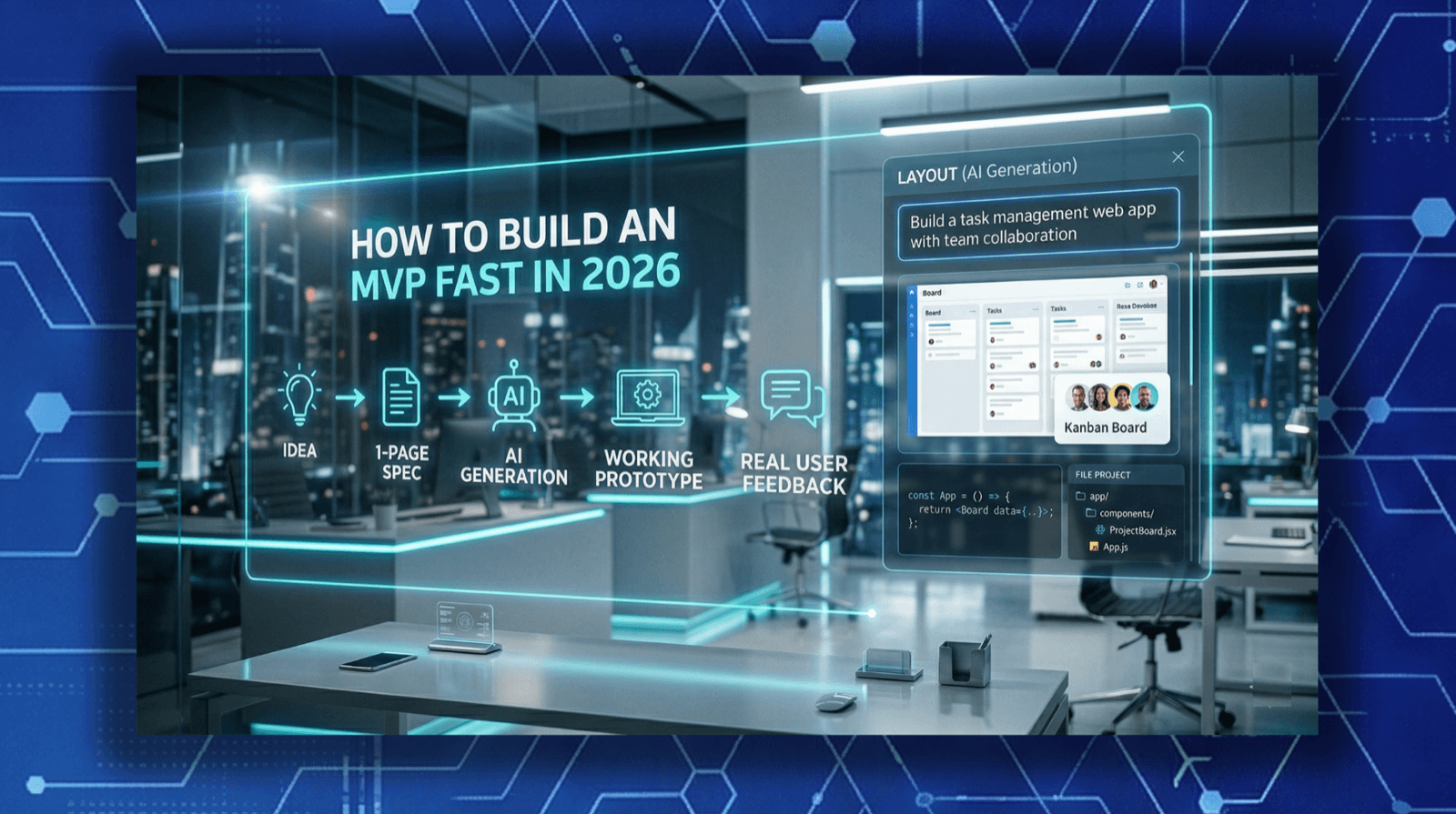
“Launch in record time” rarely means typing faster. It means eliminating the two silent killers that stretch a 2–4 week MVP into a 3–6 month slog: unclear scope and rebuilding the same foundations (auth, data models, payments, analytics) from scratch every time.
If you're in decision mode — ready to pick tools and ship — this practical guide shows you how to build an MVP fast while creating something you can actually learn from.
Key Takeaway: An MVP is a learning vehicle, not a mini version of your final product. As Atlassian explains (citing Eric Ries), it’s “the version that enables the maximum amount of validated learning…with the least effort.” Keep speed focused on learning, not on cutting corners.
In 2026, AI app builders for prototypes have changed the game. Tools like Layout let you describe your idea in plain language and instantly generate clean code, UI components, and a full project structure — slashing setup time so you can focus on validation instead of boilerplate.
The Real Reason You Can Launch an MVP Fast
Fast MVPs aren’t magic. They come from three deliberate choices:
- Define exactly what “done” means before writing a single line of code.
- Choose boring, proven foundations for auth, database, and instrumentation.
- Timebox every learning loop so assumptions don’t consume weeks.
This aligns perfectly with the Lean Startup mindset: validated learning with minimal effort, not a half-baked final product.
Step 1 — Write the 1-Page Spec That Kills Scope Creep
Your goal: a spec so clear that a stranger (or an AI app builder) could build it without constant questions.
Keep it to one page and make it concrete.
Include:
- One target user persona and their core job-to-be-done.
- The 5–7 step “core loop” (e.g., Sign up → Create first project → Perform main action → See result → Save & return).
- Must-have screens (usually 3–5).
- One success metric you’ll measure in the first 7 days after launch.
Cut (for now):
- Complex roles & permissions beyond owner/member.
- Fancy onboarding flows.
- Multi-tenant edge cases or “v2” integrations.
- Full design system work.
Done when: You can point to the spec and confidently say, “If we ship only this, will we learn whether the idea is real?” Plus, you have a clear “not building” list.
Pro Tip for 2026: After drafting your spec, paste it into an AI app builder for prototypes like Layout to generate the initial structure in seconds.
Step 2 — Pick the Smallest Stack That Can Still Be Real
Treating “fast” as “hacky” is a common founder mistake. Aim for small but production-ready:
- Real authentication (not fake logins).
- A real database.
- Basic error tracking.
- Analytics to measure actual user behavior.
This prevents the silent timeline killers: rebuilding auth mid-project, painful data migrations, or launching without answers to “where are users dropping off?”
MVP Foundations to Decide Upfront:
- Auth: Email/password or simple SSO?
- Data: Core entities only (User, Workspace, Project, etc.).
- Payments: Only if charging is part of your immediate hypothesis.
- Instrumentation: 5–8 key events tied to your core loop.
Done when: You can explain your architecture in 60 seconds and you’ve resisted nice-to-haves.
Step 3 — Build (or Generate) the Core Flow — and Only the Core Flow
Your build sprint should feel repetitive and focused:
- Implement one step of the core loop.
- Verify it end-to-end.
- Instrument it.
- Move on.
Typical sequence for most SaaS/web MVPs:
- Sign-up / login (just enough to protect data).
- Create the first object (the “moment of ownership”).
- Complete the primary action.
- Show a result (dashboard, output, or artifact).
- Save + return (so users come back).
Done when: A user can complete the full core loop without you guiding them — and nothing depends on a “coming soon” feature.
2026 Acceleration Hack: Use an AI-powered app builder like Layout to generate the entire starter project (UI components, routes, backend structure) from your spec. Then refine only the core loop. This can save days or weeks of setup.
Step 4 — Instrument It Like You’ll Need Answers Next Week
A fast launch without measurement isn’t a launch — it’s a guess.
Track 5–8 events that map directly to your core loop:
- Account created
- First project created
- Key action completed
- Result viewed
- Invite sent (if relevant)
- Payment started/completed (if relevant)
This lets you answer:
- Where do users drop off?
- What correlates with retention?
- Which feature is a distraction?
Remember Steve Blank’s framing: hypotheses first, then experiments and tests. Instrumentation turns your MVP into a true learning engine.
Done when: Your dashboard clearly shows activation, and you can reproduce errors quickly.
Step 5 — Ship to a Narrow Cohort and Iterate
For record-time launches, ship small first:
- 10–30 users you can talk to directly.
- One primary use case.
- One clear onboarding path.
Practical 2-Week Timebox (Solo or Small Team):
- Week 1: Spec + foundations + first end-to-end core loop (or generate baseline with AI).
- Week 2: Tighten UX, fix bugs, add instrumentation, ship to cohort.
Done when: You’ve had at least 5 real user conversations and can name the top 3 friction points with evidence (events + quotes).
Where Layout Fits: AI App Builder for Instant Prototypes (No Magic, Just Speed)
If your biggest bottleneck is turning a spec into a working full-stack skeleton (UI, routes, backend structure), AI tools shine here.
Layout — an AI app builder for prototypes — lets you describe your idea and instantly get clean, exportable code with project structure, UI components, and integrations (Supabase, Stripe, GitHub sync). You own the code and can iterate freely.
Pragmatic Workflow with Layout:
- Finish your 1-page spec (Step 1).
- Feed the description into Layout to generate the baseline app.
- Constrain everything back to your core loop.
- Review data model, auth, and flows — then apply the discipline from Steps 2–5.
The question isn’t “can it generate an app?” It’s: Does it help you build an MVP you can actually ship, measure, and iterate on — without lock-in?
FAQ: Common Questions About Building an MVP Fast
Is launching fast the same as cutting quality?
No. Fast works when you reduce scope and keep foundations “small but real.” The goal is rapid learning, not brittle code.
What should you build first: onboarding or core feature?
Always the core feature. Onboarding exists only to get users to the value moment.
Do you need payments in your MVP?
Only if charging is part of the hypothesis you must validate now. Otherwise, test usage and retention first.
What’s the biggest reason MVPs miss deadlines?
Scope creep — usually disguised as “just one more feature.” Your one-page spec + “not building” list is the best defense.
How do AI app builders like Layout compare to Lovable or Replit?
They all accelerate prototyping, but Layout emphasizes clean, owned full-stack code with easy export and integrations — ideal for founders who want speed without sacrificing future flexibility.
Next Steps: Your Quick MVP Checklist
If you’re ready to ship faster in 2026:
- Write your one-page spec today.
- Decide your MVP primitives (auth, DB, instrumentation).
- Set a two-week timebox and pick a narrow cohort.
- If setup is your blocker, try Layout to generate a working baseline from your prompt — then apply the discipline above.
Ready to turn your idea into a testable prototype in minutes instead of weeks?
Try Layout Free → (Describe your app idea and get instant code + structure)