

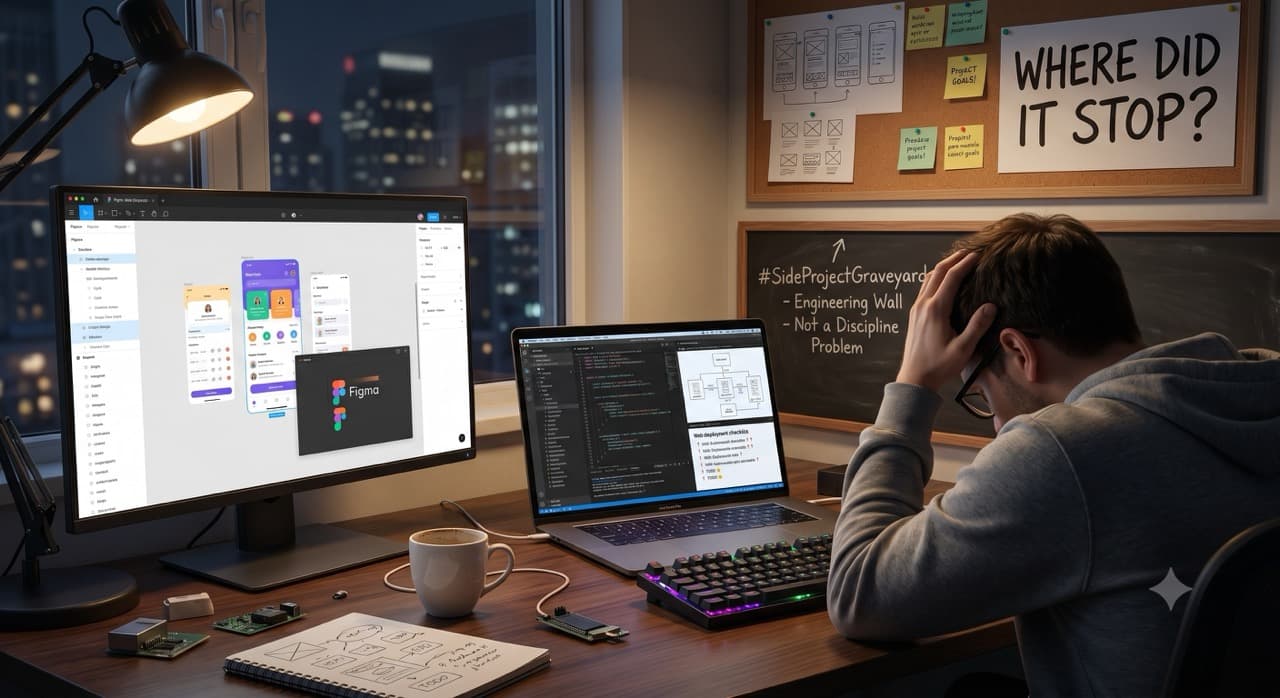
Why Side Projects Actually Stall (It's Not What You Think)
Every post-mortem says the same things: lost momentum, got distracted, failed to validate. Those are symptoms. The cause is a specific 48-hour window that happens early in every side project, when a solo builder realizes that turning a working idea into something a real user can actually touch requires backend infrastructure, deployment pipelines, auth flows, and debugging cycles that have nothing to do with the problem they originally set out to solve.
The most common answers on Hacker News threads about how to execute on side projects keep pointing to the same stall point: not ideation, not marketing — the build phase. Specifically, the gap between "I know what this should do" and "someone can use it right now."
That gap has three stages, and each one is a momentum killer.
Stage 1: Scoping hell. A "simple app" expands on contact. The one-screen tool turns into a six-tab Notion doc covering edge cases, data models, and integrations you haven't thought through yet. You're not building anymore — you're architecting. Architects don't ship.
Stage 2: Build paralysis. Bubble or Supabase or just hire someone? Each option opens a new rabbit hole. Bubble has a learning curve steep enough that you'll spend two weeks watching tutorials before you've built a single working flow. Supabase is powerful but you're now a backend developer, which wasn't the plan. A contractor costs $5,000–$15,000 minimum for an MVP, which is money you don't have for an idea that isn't proven yet.
Stage 3: Deployment dread. It works locally. It will never see a user. The jump from "runs on my machine" to "live URL I can send to someone" involves environment variables, hosting configuration, DNS, and at least one mystery error that takes six hours to diagnose. Most side projects die here, quietly, while the founder tells themselves they'll get back to it next weekend.
None of this is about discipline. None of it is about morning routines or productivity systems. It's about the distance between idea and live product being measured in engineering skills most solo founders don't have and can't afford to hire.
How to Execute on Side Projects: Collapse the Gap
The fix isn't more willpower. It's eliminating the phases where momentum dies. That's what Layout.dev is built to do — take the distance between "I have an idea" and "someone can use this right now" and compress it to a single session.
Here's what that actually looks like in practice.
A realistic example: shipping a client reporting dashboard
Say you're a freelance consultant. You've been emailing clients PDF reports every week, they always want changes, and the back-and-forth is eating your Friday afternoons. The app you need is simple: clients log in, see their live metrics, and can leave comments. You've had this idea for four months.
In the old path, this is a three-week project minimum — authentication, database, frontend, deployment, and a weekend you'll never get back. In Layout.dev, here's what the actual workflow looks like:
- You open Layout.dev and describe the app in plain language: "A client portal where each client logs in and sees a dashboard of their weekly metrics. They can leave comments on any metric. I update the data manually or via CSV upload."
- Layout generates the app structure — data model, user roles, views, and the core interaction. You're not configuring a blank canvas; you're editing something that already works.
- You connect your data. If you're uploading CSVs, that's built in. If you're pulling from a spreadsheet or an external source, the connectors are already there. No custom API work.
- You adjust the views — rename fields, rearrange layout, swap the color. This takes minutes, not hours, because you're working on a working app, not assembling one from scratch.
- You click deploy. One click. There's no environment configuration, no hosting decision to make, no mystery error between local and live. You get a URL.
- You send that URL to your first client.
Start to live URL: one session. The idea you've had for four months is now something a real person can open.
Why no-code isn't automatically the answer
If you've tried Bubble before and hit a wall, that experience was real — and it wasn't your fault. Bubble is genuinely powerful. It's also a platform you have to learn before you can build on it. The learning curve is steep enough that most first-time users spend significant time understanding how Bubble thinks before they've shipped anything. That's the Bubble trap: you signed up to build, and you ended up studying.
The same dynamic shows up with tools like Lovable, which excels at generating impressive prototypes quickly. But a prototype isn't a product. Lovable gets you to "this looks like the thing" fast — and then leaves you at the gap between demo and deployed, monetizable app that real users can access.
Layout.dev is optimized for a different outcome. Not "impressive in a Loom video" — live, shareable, monetizable. The platform makes decisions that prioritize shipping over configurability. That's a deliberate tradeoff, and it's the right one for a solo founder with limited runway and a working idea that needs to be tested against real users before next month's rent is due.
No-code app builders for founders should do one thing above everything else: remove the engineering wall. Not replace it with a platform-expertise wall.
The Weekend Execution Playbook
This is how to go from idea to product in a single weekend — not theoretically, but in practice.
- Write the problem in one sentence. Not the app, not the features — the problem. "My clients can't see their progress without me sending them a PDF every Friday."
- Identify the single action your first user needs to take. Not the full feature set — the one thing. "Client logs in and sees this week's numbers."
- Open Layout.dev and describe the app. Use the same plain language you'd use to explain it to a smart friend. The AI builds from your description. You edit from there.
- Deploy. One click. Don't skip this step or defer it to "when it's more polished." A live URL changes how you think about the product. It also changes how the people you send it to think about you.
- Send the link to five people who have the problem. Not your friends. People who would actually use it. Their friction points in the first session are worth more than any amount of planning.
That's the playbook for how to ship a side project fast. No contractor. No three-week backend setup. No Sunday-night graveyard.
What to Take Away
- Execution failure on side projects is a structural problem, not a personal one — the build phase is where the majority of solo founders stall, not ideation or marketing.
- The gap between working idea and live product is an engineering gap. The fix is a build environment that closes that gap, not more discipline applied to the same broken process.
- Tools that stop at "impressive prototype" (Lovable) or require platform expertise before you can ship (Bubble) don't solve the problem — they relocate it.
- Going from idea to product to live URL in a single weekend is achievable with the right tooling. One-click deployment isn't a minor feature; it's the difference between something that exists and something that never leaves your laptop.
- The real test of any side project isn't whether it works locally. It's whether someone who has the problem can use it today.
Ship Your First Version This Weekend
The idea you've been sitting on isn't going to get easier to build with more time. More time just means more tabs, more second-guessing, and another Sunday night with nothing a user can touch.
Start building for free → Ship your first version this weekend.