

What is prompt engineering?
Prompt engineering is the practice of structuring prompts in a way that helps AI understand exactly what you want to create.
Instead of giving vague instructions like:
“Build a dashboard.”
A stronger prompt might be:
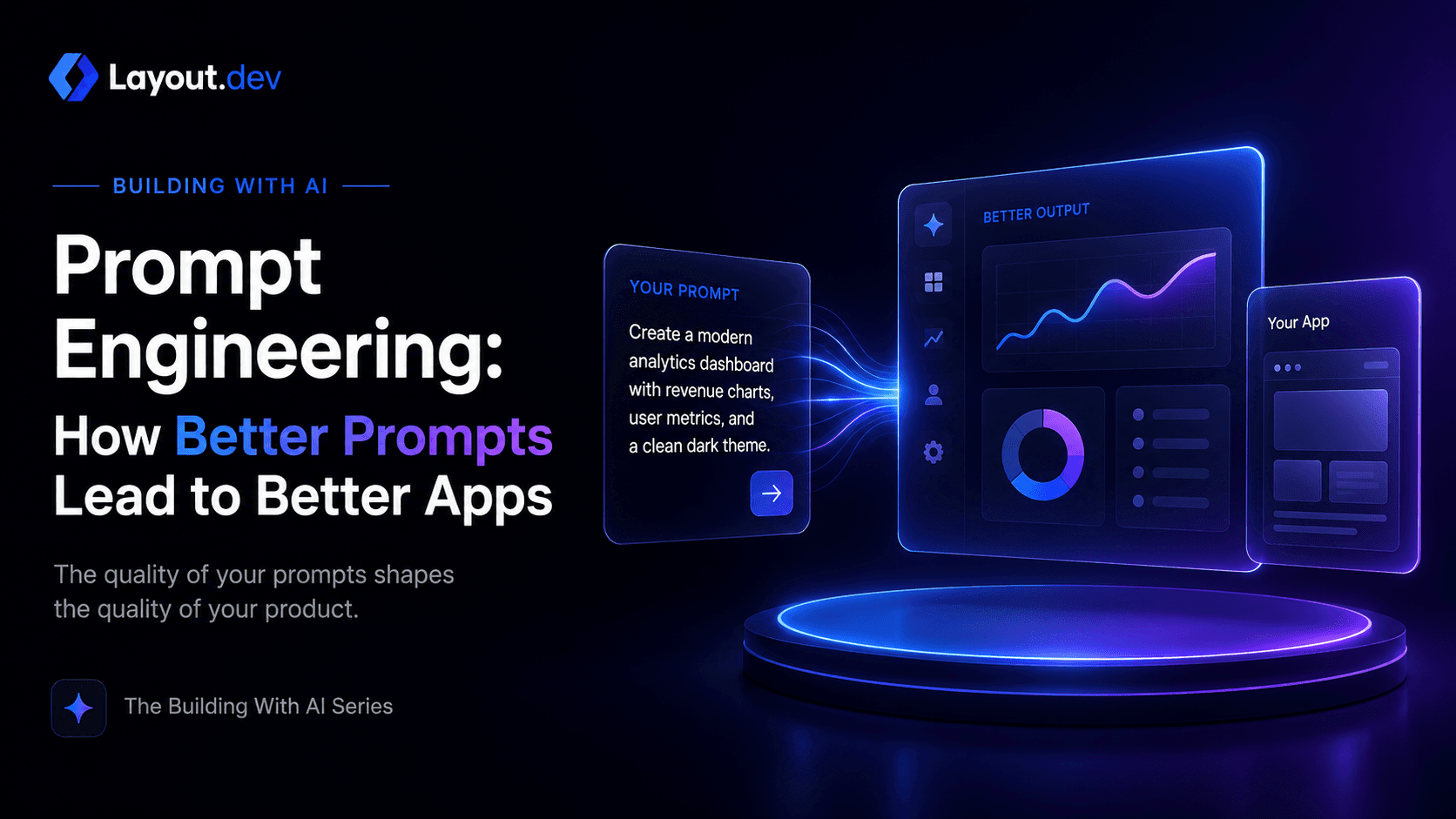
“Create a modern SaaS analytics dashboard with a dark theme, a collapsible sidebar, revenue charts, user activity metrics, and a mobile-responsive layout.”
The difference is context.
The more clearly you communicate your vision, the more effectively the AI can translate it into a usable product.
In AI app building, prompts become the starting point for:
- layouts
- features
- workflows
- styling
- navigation
- interactions
- overall user experience
In many ways, prompting is becoming a new form of digital direction.
Why prompting matters so much in AI app building
AI builders move fast. But because they move fast, they rely heavily on guidance.
The AI doesn’t automatically know:
- your design taste
- your product goals
- your target audience
- your preferred workflows
- how polished or minimal you want the experience to feel
Your prompts help shape all of that.
A vague prompt often leads to generic outputs. A detailed prompt creates more intentional and refined results.
That’s why experienced AI builders spend less time fighting the AI and more time learning how to communicate with it effectively.
What makes a good prompt?
Strong prompts usually include three things:
1. Clear intent
The AI needs to understand what you’re actually trying to build.
Instead of:
“Make a homepage.”
Try:
“Create a homepage for an AI productivity startup targeting solo founders.”
Specificity immediately improves the output.
2. Visual direction
AI responds surprisingly well to design references and stylistic guidance.
For example:
- modern and minimal
- dark mode
- glassmorphism
- startup-style UI
- clean dashboard layout
- bold typography
- mobile-first design
These details help shape the visual experience of the app.
3. Functional context
Good prompts explain how the product should behave — not just how it should look.
For example:
“Add a sidebar that collapses on mobile.”
“Allow users to filter projects by category.”
“Create a smooth onboarding flow with progress indicators.”
This helps the AI generate products that feel more complete and usable.
Prompting is an iterative process
One of the biggest misconceptions about AI building is that the first prompt creates the final product.
In reality, the best results usually come through iteration.
You might start with:
“Create a clean finance dashboard.”
Then refine it with:
- “Use softer colors.”
- “Add better spacing.”
- “Make the charts larger.”
- “Simplify the navigation.”
- “Turn this into a mobile layout.”
Each prompt improves the experience step by step.
That’s why many people compare AI app building to creative collaboration more than traditional software development.
Common prompting mistakes
As AI builders become more popular, certain mistakes show up repeatedly.
Being too vague
Prompts like:
“Make it better.”
don’t give enough direction.
The AI performs better when feedback is specific.
Overloading one prompt
Trying to describe an entire product in one giant paragraph can confuse the workflow.
It’s often better to build gradually:
- structure first
- then styling
- then interactions
- then refinements
Ignoring iteration
The first output is rarely the best output.
The builders getting the strongest results are usually the ones refining constantly.
Why prompt engineering is becoming a real skill
As AI tools continue evolving, prompting is becoming more than just typing instructions into a chat box.
It’s becoming a new way of thinking about creation.
People who know how to communicate ideas clearly, structure workflows, and guide AI effectively can build faster, prototype quicker, and experiment more freely than ever before.
In many ways, prompt engineering is less about “talking to AI” and more about translating ideas into products efficiently.
That’s why it’s quickly becoming one of the most important skills in modern AI-powered building.
The future of AI building
The future of software creation probably won’t belong entirely to developers or entirely to AI.
It will belong to people who know how to direct both.
Platforms like Layout.dev are making that process more accessible by allowing builders to turn prompts into real applications faster and more visually than traditional workflows ever allowed.
And as AI tools continue improving, the ability to guide, refine, and communicate ideas effectively may become just as valuable as technical knowledge itself.