

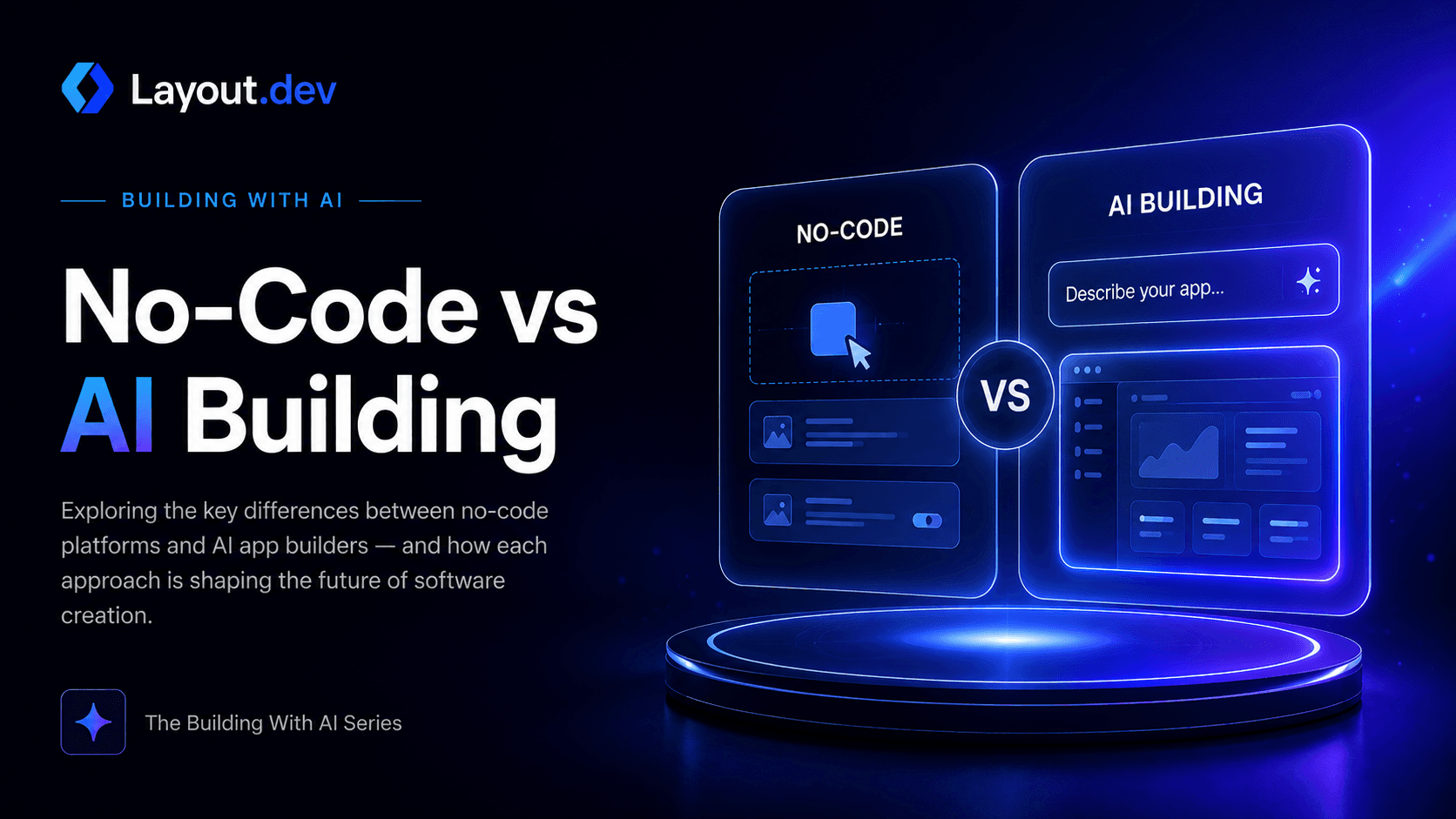
At first glance, no-code platforms and AI app builders may seem similar. Both are designed to simplify software creation and make development more accessible. But the way they work — and the experience they create — is fundamentally different.
No-code platforms still rely heavily on manual building. Users are responsible for designing interfaces, connecting workflows, configuring logic, structuring databases, and building applications piece by piece. While the process is significantly easier than traditional coding, it still requires time, platform knowledge, and hands-on setup.
AI app builders shift the experience from manual construction to AI-assisted creation.
Instead of building every element individually, users can describe what they want in plain language. The AI then helps generate layouts, components, workflows, and functionality automatically — dramatically reducing the gap between idea and execution.
For example, instead of manually configuring multiple pages and workflows, a user could simply type:
“Create a client dashboard with user authentication, analytics tracking, and payment management.”
Within seconds, the AI can begin generating the structure of the application.
That difference changes the entire building experience.
No-code platforms focus on visual development.
AI app builders focus on intelligent generation.
In many ways, AI app builders represent the next evolution of the no-code movement. They don’t necessarily replace visual building tools — they accelerate them.
The biggest advantage of AI-powered building is speed.
Traditional development often requires:
- planning
- wireframing
- frontend setup
- backend configuration
- database structuring
- testing
- iteration
Even with no-code tools, much of this process still happens manually.
AI app builders simplify that workflow by helping automate large portions of the setup process. This allows users to move from concept to prototype significantly faster than before.
The result is a more intuitive creation experience — one where users spend less time figuring out how to build, and more time focusing on what they want to create.
This shift is especially important for:
- startups moving quickly
- founders validating ideas
- teams building internal tools
- creators launching products
- businesses experimenting with new workflows
As AI continues to evolve, software creation is becoming more accessible than ever before.
The future of app development will likely combine:
- AI-powered generation
- visual editing
- customization
- automation
- human creativity
Together.
No-code changed who could build software.
AI app builders are changing how fast ideas can become reality.
And we’re only getting started.