

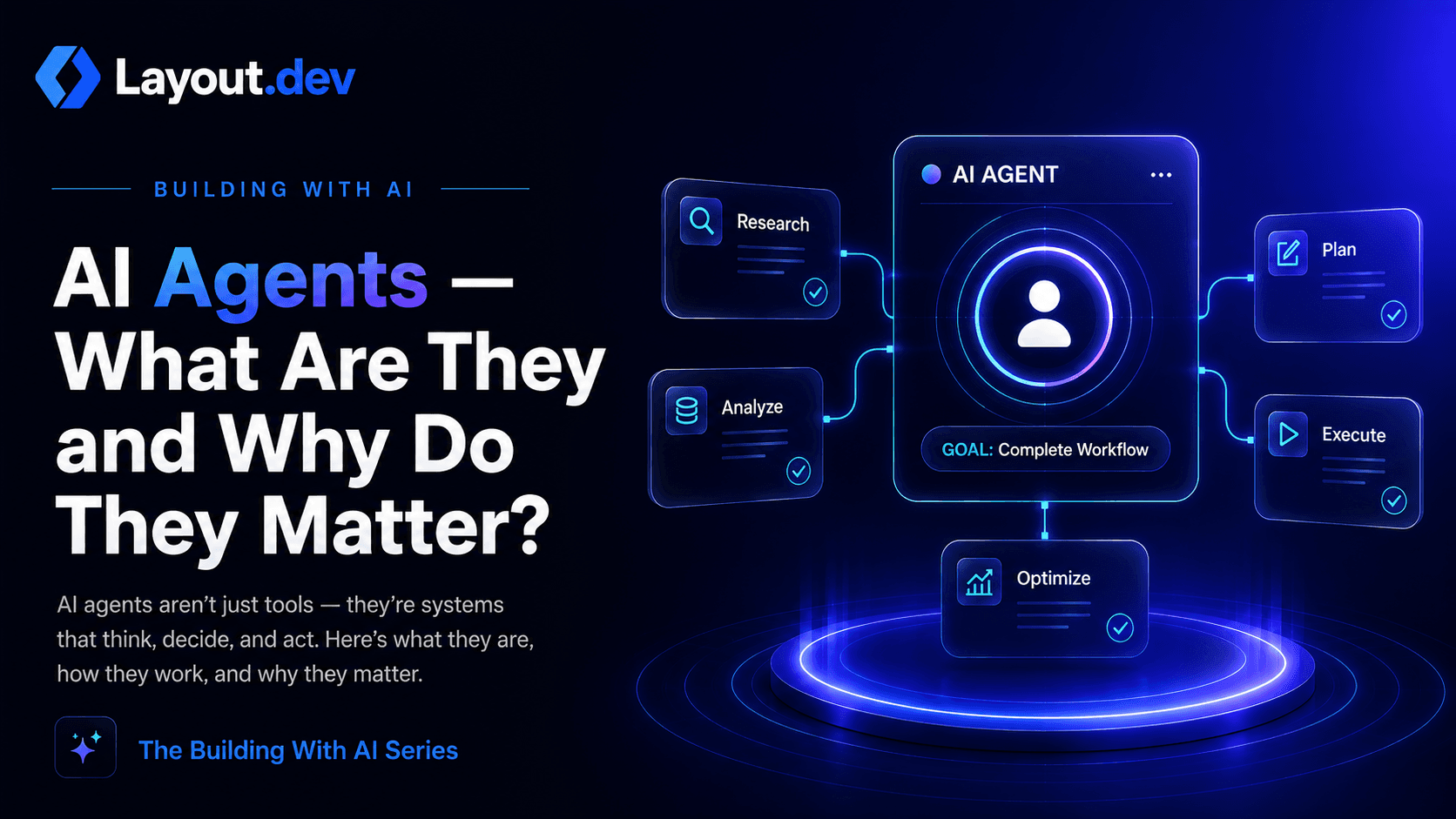
What is an AI agent?
An AI agent is an AI-powered system that can independently perform tasks on behalf of a user.
Unlike a traditional chatbot that waits for instructions one message at a time, an AI agent is designed to:
- understand goals
- make decisions
- take multiple steps
- use tools or systems
- adapt based on results
- and continue working toward an outcome
In simple terms:
a chatbot gives answers.
An AI agent gets things done.
How AI agents actually work
AI agents usually combine:
- large language models (LLMs)
- memory/context
- workflows
- reasoning systems
- integrations/tools
- and decision-making logic
Instead of stopping after generating a response, the agent evaluates:
“What should happen next?”
For example, an AI agent might:
- research information
- organize data
- send updates
- generate content
- analyze feedback
- manage workflows
- or trigger actions across multiple systems
All while continuously adjusting based on the goal it was given.
That’s what makes agents feel fundamentally different from traditional AI interactions.
AI agents vs regular AI chatbots
A lot of people confuse AI agents with normal AI assistants, but there’s an important difference.
A standard chatbot interaction usually looks like this:
- user asks a question
- AI responds
- conversation ends
An AI agent workflow is more active:
- user gives a goal
- AI plans steps
- AI performs actions
- AI evaluates results
- AI continues iterating until the task is completed
The AI is no longer just generating text.
It’s operating within a process.
Why AI agents matter
AI agents matter because they reduce the amount of manual coordination required to complete complex tasks.
Instead of switching between:
- apps
- tabs
- workflows
- documents
- prompts
- dashboards
- and repetitive actions
users can increasingly delegate parts of the process itself.
This changes how people think about productivity, software, and even digital work.
The long-term shift isn’t just:
“AI helps me.”
It’s:
“AI handles parts of the workflow for me.”
Real-world examples of AI agents
AI agents are already starting to appear in:
- customer support systems
- research tools
- productivity platforms
- marketing workflows
- development tools
- automation systems
- internal business operations
- and AI app builders
For example:
A marketing agent
could:
- generate campaign ideas
- write social posts
- analyze performance
- suggest optimizations
- and organize content calendars
A development agent
could:
- generate app structure
- debug workflows
- update interfaces
- test functionality
- and improve layouts
A research agent
could:
- collect information
- summarize findings
- compare sources
- organize reports
- and continuously refine outputs
The important part is that the AI isn’t just answering questions anymore.
It’s participating in execution.
Why AI agents are becoming so popular
There are a few major reasons AI agents are suddenly everywhere.
AI models became more capable
Modern AI systems are significantly better at:
- reasoning
- context retention
- long-form planning
- multi-step tasks
- and understanding intent
Without those improvements, agents wouldn’t work reliably.
People want outcomes, not tools
Most users don’t actually care about the technical process behind software.
They care about:
- launching faster
- automating repetitive work
- building products quicker
- organizing workflows
- and saving time
AI agents move closer to outcome-driven software instead of purely manual tools.
The rise of AI-powered building
As AI app builders grow, more users are discovering they can create systems that behave more intelligently and autonomously.
Instead of static apps, people are starting to build:
- responsive workflows
- smart automations
- adaptive systems
- and AI-powered user experiences
That’s a major shift in how software is being created.
Are AI agents replacing people?
Not really.
At least not in the way most headlines suggest.
AI agents are much better understood as workflow multipliers.
They reduce repetitive coordination work and speed up execution, but human direction, creativity, judgment, and decision-making still matter heavily — especially in higher-level or complex environments.
In many cases, the real advantage comes from:
humans + AI agents working together.
The future of AI agents
AI agents are still early.
Right now, most systems are somewhere between:
- assistant
- automation
- and semi-autonomous workflow tools
But the direction is clear:
AI is moving from passive generation toward active execution.
As these systems improve, we’ll likely see:
- smarter workflows
- more autonomous tools
- better memory/context handling
- deeper integrations
- and more personalized AI systems
The idea of software that can actively help build, organize, analyze, and operate alongside users is becoming increasingly real.
And for creators, builders, startups, and teams, that changes what’s possible entirely.
Final thoughts
AI agents represent one of the biggest shifts happening in software right now.
Not because they replace humans — but because they fundamentally change how work gets done.
The future of AI likely won’t just be about generating content or answering questions.
It will be about systems that can collaborate, reason, adapt, and help execute ideas at an entirely different scale.
And we’re only at the beginning.