

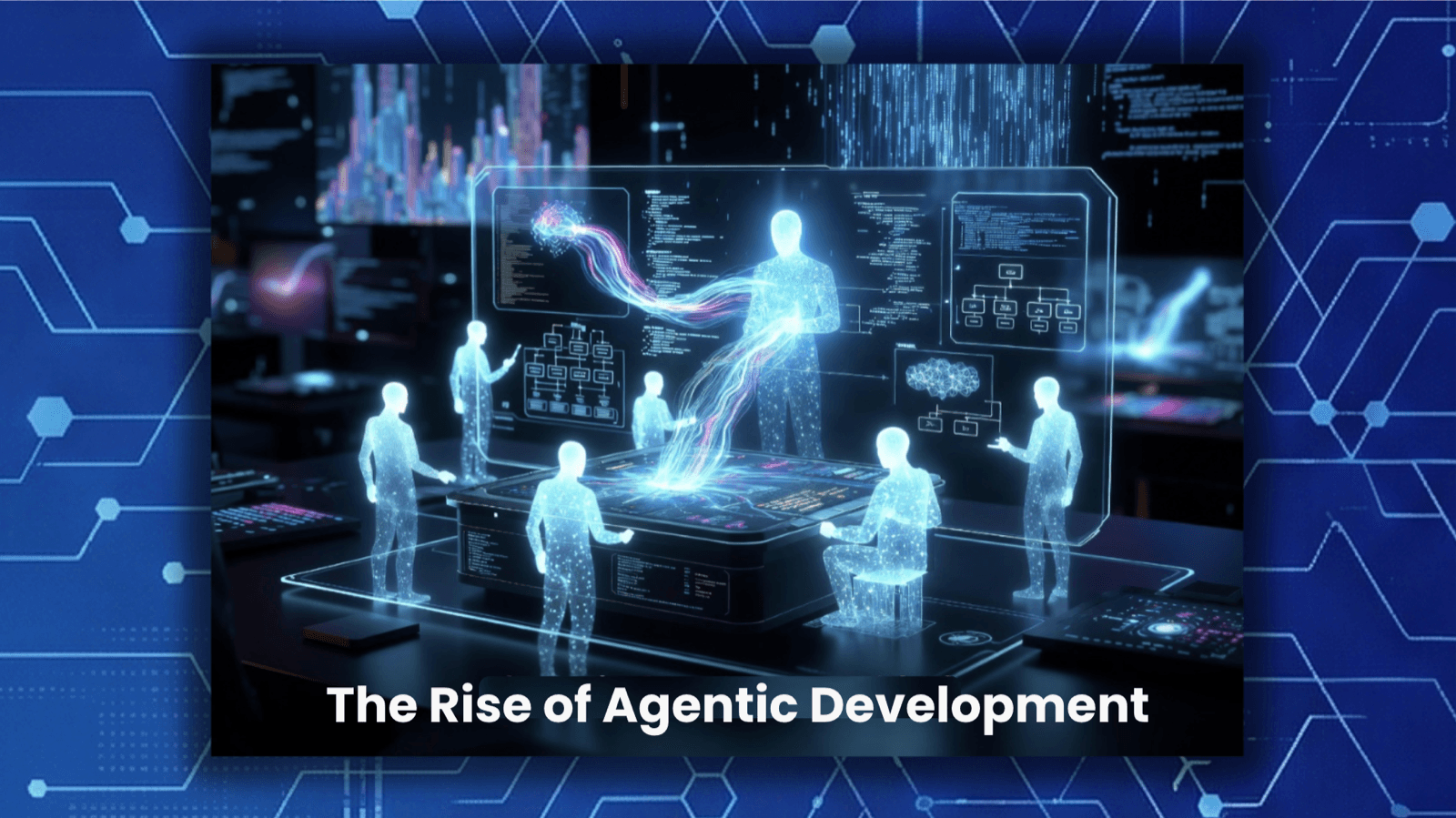
Understanding Agentic Development
Agentic development is an innovative software engineering approach in which autonomous AI agents manage entire development tasks from start to finish. Instead of simply suggesting code like traditional tools, these agents think strategically, make decisions, adapt to challenges, and deliver production-ready results with minimal supervision.
Core capabilities include:
- True autonomy — Operates independently on complex tasks
- Intelligent reasoning — Evaluates architecture and chooses optimal solutions
- Relentless iteration — Debugs issues and keeps improving until success
- Deep tool integration — Works with your codebase, databases, tests, and CI/CD
- Project memory — Maintains full context across your application
How Agentic Development Stands Apart from Previous Tools
- Traditional Development: Everything done manually by humans — reliable but slow
- AI Code Assistants: Helpful for suggestions and autocompletion, but still require constant human direction
- Prompt-Based Generation: Fast for quick prototypes, but often lacks depth and reliability
- Agentic Development: Full end-to-end autonomy for real production work
You describe the goal in plain language, and the agent handles the rest.
Inside the Agentic Development Process
- Describe the Task Naturally — Explain what you need in everyday language
- Intelligent Planning & Execution — The agent studies your codebase and builds a smart strategy
- Automatic Debugging & Refinement — Identifies problems, fixes them, and validates results
- Multi-Agent Teamwork — Specialized agents collaborate on different parts of the task
- Seamless Deployment — Creates pull requests and deploys changes automatically
Single-Agent vs Multi-Agent Orchestration
| Aspect | Single-Agent | Multi-Agent |
|---|---|---|
| Structure | One AI agent handles everything | Multiple specialized agents + central orchestrator |
| Speed | Slower (sequential work) | Much faster (parallel work) |
| Specialization | Generalist (jack of all trades) | Experts in their domain (Backend, Frontend, etc.) |
| Complexity Handling | Good for simple tasks | Excellent for complex, multi-part features |
| Quality | Moderate | Higher (each agent focuses on its strength) |
| Coordination | None needed | Orchestrator manages communication & integration |
| Debugging | One agent fixes its own issues | Specialized agents help each other |
| Scalability | Limited | Highly scalable |
| Best For | Small tasks, quick prototypes | Production features, large applications |
Practical Examples of Agentic Development in Action
- “Build a real-time analytics dashboard for user engagement” → The agent creates the backend API, frontend components, database schema, and visualization widgets with full responsiveness
- “Integrate Stripe subscriptions with usage-based billing” → Handles payment flows, webhook processing, customer portal updates, and invoicing logic across the app
- “Optimize slow database queries in the reporting module” → Analyzes performance bottlenecks, rewrites queries, adds indexing, and implements caching
- “Create a customizable notification system” → Builds email, in-app, and push notification infrastructure with user preferences and delivery tracking
Why 2026 Marks the Rise of Agentic Development
Advanced AI models now have the reasoning power and context understanding needed for sophisticated, multi-step projects. Combined with mature tooling and rising pressure to deliver faster, agentic AI has become the smartest way to scale software development.
How layout.dev Enables Powerful Agentic Workflows
layout.dev was designed from the ground up to support agentic development. It’s more than just another AI coding tool — it’s a complete platform built for autonomous software creation, from ideation to monetization.
- Robust Agents API for deep workflow integration
- Sophisticated multi-agent coordination
- One-click backend, database & payment gateway integrations
- One-click deployments
- Strong enterprise security and compliance features
The Future of Software Engineering is Agentic
Agentic development doesn’t replace developers — it dramatically amplifies their impact. The strongest teams going forward will excel at guiding AI agents while applying human creativity and strategic thinking.
The real question is: Will you embrace agentic development early and gain a competitive edge?
Ready to accelerate your development? Try layout.dev today and experience the power of agentic AI development.